
Automated storage systems
High-bay warehouse
Automatic storage and retrieval machines
Automated high-bay warehouses are loaded and unloaded by storage and retrieval machines (SRMs) that are controlled by complex automation systems. For these applications, the WinMOD-SIMLINE system offers a comprehensive 3D library with typical SRM variants that can be flexibly parameterised in their dimensions. This makes it possible to realise unit load SRMs for single or double-deep pallet and container warehouses as well as highly dynamic mini-load SRMs for small load carriers, cartons or trays.
The routes of the RBGs are created using parameterisable 3D ground rail elements such as straights, curves and points. This allows you to virtually realise any given rail layout, including aisle changes. There are also 3D library elements for the many different load handling devices such as telescopic forks, grippers or satellite and shuttle systems for channel warehouses.
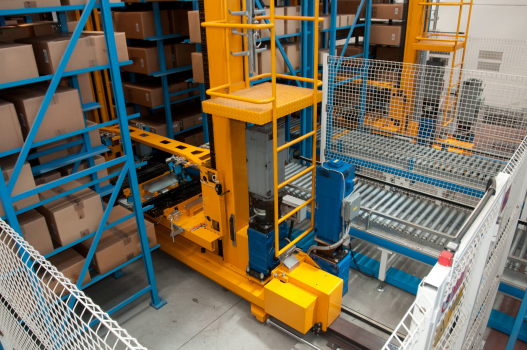
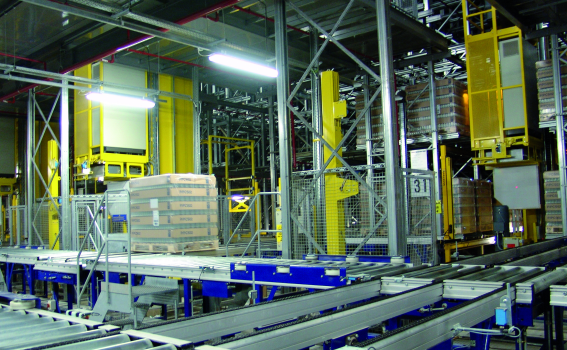
High-bay warehouse with warehouse management system
3D shelving elements with a dynamically adjustable number of levels and compartments are available for fast and efficient mapping of the storage area. These are loaded with virtual 3D warehouse goods that receive individualised information directly from the real warehouse management system.
This means that virtual commissioning (VIBN) of complex control and warehouse management systems can also be carried out completely and realistically. Operating strategies such as single or dual command for route and strategy optimisation, as well as tracking via barcode or RFID, can be tested in a targeted manner.
As such systems usually consist of several automation units, WinMOD enables the simultaneous connection of several controllers via different fieldbus architectures - for comprehensive, parallel simulation and commissioning.
Further factory automation solutions
Sorting and picking systems for small goods such as cartons, plastic boxes or other piece goods. The goods are transported via classic roller conveyors, belt conveyors
as well as the typical cam roller tracks,
Belt curves and accumulating roller conveyors.

This technology area comprises conveyor systems that transport and sort pallets and pallet cages. The conveying elements are large roller and chain conveyors in combination with lifting, turning and sliding tables. Magazines for empty pallets are also typical here.
These systems are usually fully automated high-bay warehouses that are operated by storage and retrieval machines and controlled via distributed automation systems. The orders for storage and retrieval are generated via warehouse management systems.
Automated systems that pick up parts from A to B and set them down again with a defined orientation - typically for loading, sorting, picking or packing. Core systems are industrial robots (Delta, SCARA, 6 axes, Cartesian) or gantry axes.
Robotics plays a central role in modern manufacturing by enabling the automation of production processes and increasing efficiency and precision. Robots are used in various areas, such as welding, assembly, painting or packaging of products.

Production lines combine processes, material flow and control systems to create a production system with cycle and quality assurance. They consist of combinations of assembly, processing and testing stations. They also include transfer technology, buffers and often a highly specialised automation system.

Electric monorail systems are used as connecting conveyor technology over long distances. The overhead trolleys travel fully automatically with integrated electric drives and controls and are usually routed via a centralised control system.
This chain-driven overhead or floor conveyor technology is driven by continuously running power strands (chains). Transport trolleys are engaged, transported, disengaged at stoppers and buffered via chain dogs.
Automated self-driving vehicles as a connecting material flow solution. Driving takes place either completely track-free via defined lanes or markers (AGV) or via free navigation with automatic dynamic obstacle avoidance (AMR).

Engineering discipline for the development, manufacture and maintenance of machines, plants and production systems. Typical applications include machine tools, handling technology, automotive/aerospace, packaging and assembly systems.