
Robotics & pick-and-place systems
Factory automation solutions from WinMOD
Robotics
Integration of industrial robots into the VIBN
Industrial robots and robot tools
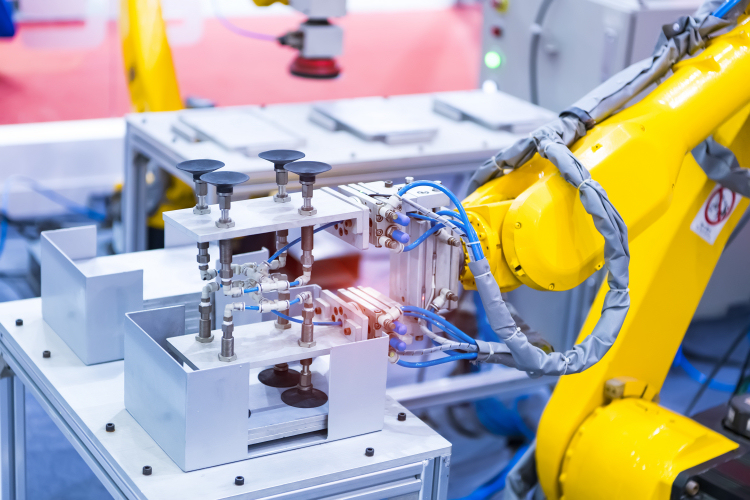
Industrial robots are a core technology in many technology sectors and are offered by many different robot manufacturers. They are categorised into the general types Delta, SCARA, 6-axis and Cartesian. We therefore offer a large number of 3D robot libraries from well-known manufacturers for virtual commissioning (VIBN). Many 6-axis articulated robots form the basis, but specialised models such as palletisers with compensating mechanisms or small robots for pick-and-place applications for small parts are also available.
From the welding cell to component assembly, WinMOD-SIMLINE naturally also supplies a large selection of parameterisable 3D elements for tilting, turning and clamping devices, consoles, linear axes and tool changing systems. It is also possible to enrich these devices with individual 3D CAD data in order to integrate customised solutions. The WinMOD-SIMLINE 3D sensor system is used for 3D part detection, which guarantees precise detection of the objects in real time.
Robots via co-simulation
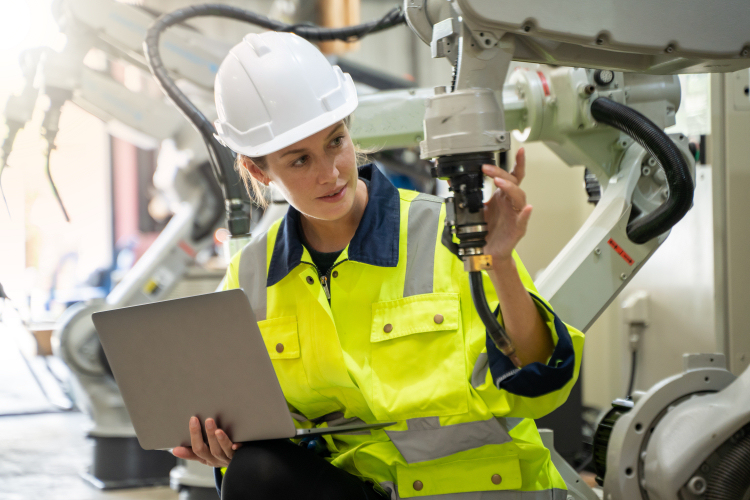
For the seamless integration of industrial robots into automated production processes, it is important to test the robot programmes as well as the automation system. Many robot manufacturers offer their own simulation software for this purpose, in which one or more robots can be run with the original code. In co-operation with many robot manufacturers, we have online links to these simulation tools and can exchange the axis data and communication signals with WinMOD in real time.
This concept of co-simulation makes the VIBN of production processes with robotics very efficient and meaningful. The entire communication from robot to system control is tested at a very early stage. All findings from offline programming (OPL) flow directly into the VIBN.
If no robot programmes are yet available for a software test, this is also no problem. With WinMOD's own Robcase simulation concept, you can create and run robot sequences directly in our software.
Pick-and-place systems
Automated component handling and manufacturing processes
Pick-and-place with robots and gantry systems
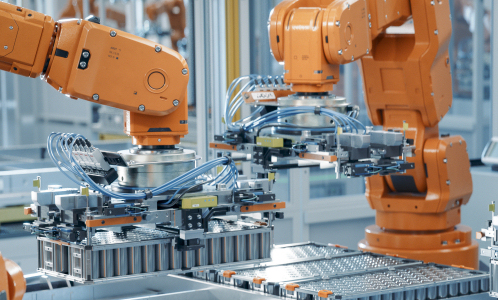
The main components of this technology area are the handling units. Today, more and more classic industrial robots are being used here, from small to large and from a wide variety of robot manufacturers. We therefore offer a large number of 3D robot libraries from well-known manufacturers for virtual commissioning (VIBN).
Portal systems are another important technology. These are often highly customised in-house developments from system suppliers. Our 3D multi-axis gantries can therefore be freely parameterised in terms of size, shape and axis configuration. Of course, you can also import the CAD design data of your customised gantry system. In our 3D editor, you have the option of preparing this data for the simulation and defining travel paths, reference points and pivot points. After all, these CAD-based systems should behave exactly like the real ones in the VIBN.
Peripherals, sensors & data acquisition
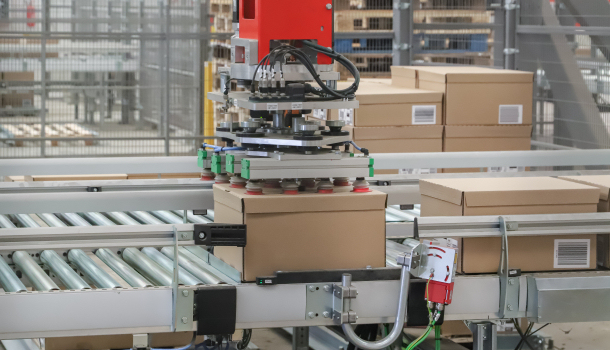
The second important part for an optimised VIBN is the simulation of the various peripheral devices. These are essentially the gripping technologies such as vacuum suction cups, centric or magnetic grippers in all possible variations. The 3D CAD data can also be imported directly for the design aspect. These are supplemented by feed systems such as roller conveyors, feeders or buffers, which you can integrate directly from our 3D conveyor technology libraries.
The third area consists of sensors and devices for data acquisition such as force and torque sensors, 2D/3D cameras for position detection, quality control and component classification. Here, too, there are extensive WinMOD libraries with virtual devices that simulate exactly the real behaviour relevant to the control system.
Finally, all virtual devices and systems are connected to the robot and system controls and put into virtual operation as a complete system. All typical processes from SMT assembly, packaging and sorting, case packing, e-commerce picking through to machine assembly can be simulated with the WinMOD-SIMLINE system.
Further factory automation solutions
Sorting and picking systems for small goods such as cartons, plastic boxes or other piece goods. The goods are transported via classic roller conveyors, belt conveyors
as well as the typical cam roller tracks,
Belt curves and accumulating roller conveyors.
This technology area comprises conveyor systems that transport and sort pallets and pallet cages. The conveying elements are large roller and chain conveyors in combination with lifting, turning and sliding tables. Magazines for empty pallets are also typical here.
These systems are usually fully automated high-bay warehouses that are operated by storage and retrieval machines and controlled via distributed automation systems. The orders for storage and retrieval are generated via warehouse management systems.
Automated systems that pick up parts from A to B and set them down again with a defined orientation - typically for loading, sorting, picking or packing. Core systems are industrial robots (Delta, SCARA, 6 axes, Cartesian) or gantry axes.
Robotics plays a central role in modern manufacturing by enabling the automation of production processes and increasing efficiency and precision. Robots are used in various areas, such as welding, assembly, painting or packaging of products.
Production lines combine processes, material flow and control systems to create a production system with cycle and quality assurance. They consist of combinations of assembly, processing and testing stations. They also include transfer technology, buffers and often a highly specialised automation system.

Electric monorail systems are used as connecting conveyor technology over long distances. The overhead trolleys travel fully automatically with integrated electric drives and controls and are usually routed via a centralised control system.
This chain-driven overhead or floor conveyor technology is driven by continuously running power strands (chains). Transport trolleys are engaged, transported, disengaged at stoppers and buffered via chain dogs.
Automated self-driving vehicles as a connecting material flow solution. Driving takes place either completely track-free via defined lanes or markers (AGV) or via free navigation with automatic dynamic obstacle avoidance (AMR).

Engineering discipline for the development, manufacture and maintenance of machines, plants and production systems. Typical applications include machine tools, handling technology, automotive/aerospace, packaging and assembly systems.