
Driverless transport systems
Automated, self-propelled ground vehicles
FTS layouts and paths
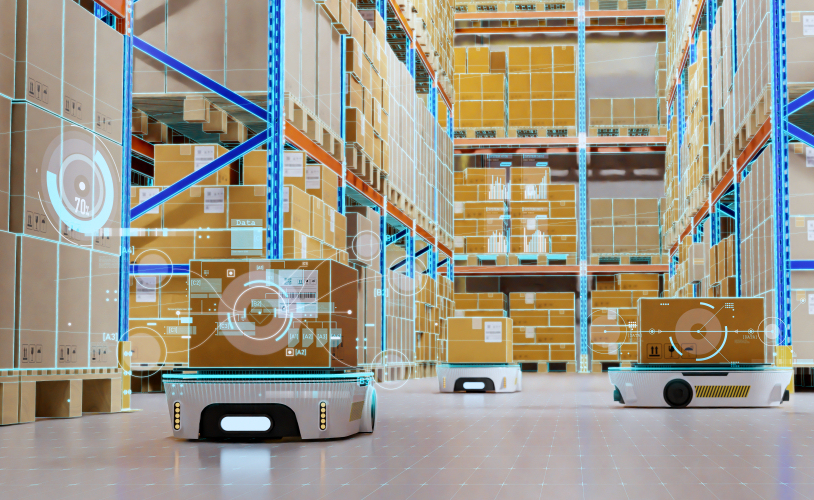
Automated guided vehicles (AGVs) automate the internal material flow from component replenishment to the removal of finished products. They consist of automated, self-propelled vehicles with built-in controllers, electric drive and battery technology. They follow predefined paths that are painted as lines on the floor, laid as magnetic or inductive belts or they follow individual floor markers, often as RFID tags.
In the WinMOD-SIMLINE system, the ground paths are modelled with parameterisable path elements such as straight lines, curves and junctions from a 3D library. The paths are thus always recognisable in the virtual 3D layout, even if they cannot be seen in reality, for example. Ground markers, obstacle objects or sensor reflectors are also installed as 3D library elements. RFID tags can be individually assigned with data. .
For virtual commissioning (VIBN), the system controller is then connected to the WinMOD system via fieldbus coupling.
AGV vehicle behaviour
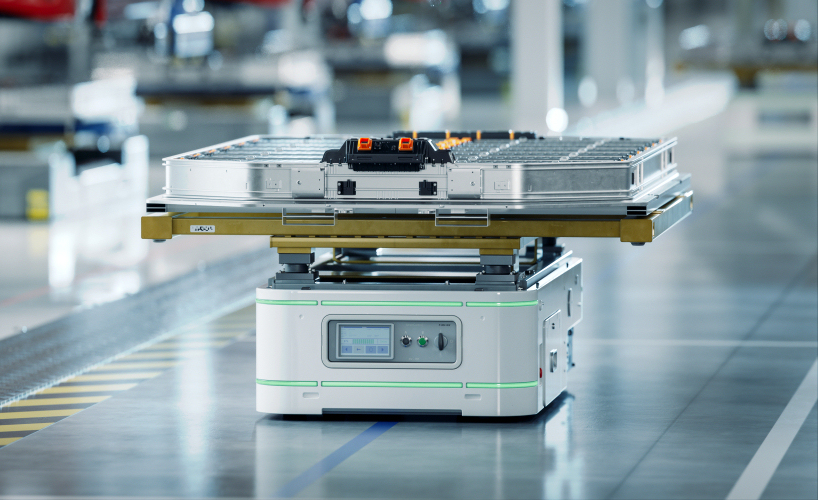
The WinMOD-SIMLINE system uses CAD-based 3D vehicle models as highly individual, customised customer solutions with individually parameterisable 3D vehicle sensors. They include all common types of underride and lift shuttles, pallet AGVs and fork AGVs.
The 3D vehicles move along magnetic or inductive strips, RFID tags or line layouts, depending on requirements. The respective path system is recorded and analysed in real time using 3D vehicle sensors, and mutual vehicle recognition and obstacle detection are simulated.
The vehicles can be loaded and unloaded with any transport goods. The direct combination with other 3D technology simulations from the WinMOD-SIMLINE system, such as robotics, is of course possible. This allows complex logistics processes such as fleet control, traffic management with prioritisation, zone regulations and track & trace functionalities to be comprehensively tested and validated. The integration of modern safety functions (e.g. scanner, emergency stop, optical signals) can also be tested and validated with these VIBNs.
Further factory automation solutions
Sorting and picking systems for small goods such as cartons, plastic boxes or other piece goods. The goods are transported via classic roller conveyors, belt conveyors
as well as the typical cam roller tracks,
Belt curves and accumulating roller conveyors.

This technology area comprises conveyor systems that transport and sort pallets and pallet cages. The conveying elements are large roller and chain conveyors in combination with lifting, turning and sliding tables. Magazines for empty pallets are also typical here.
These systems are usually fully automated high-bay warehouses that are operated by storage and retrieval machines and controlled via distributed automation systems. The orders for storage and retrieval are generated via warehouse management systems.
Automated systems that pick up parts from A to B and set them down again with a defined orientation - typically for loading, sorting, picking or packing. Core systems are industrial robots (Delta, SCARA, 6 axes, Cartesian) or gantry axes.
Robotics plays a central role in modern manufacturing by enabling the automation of production processes and increasing efficiency and precision. Robots are used in various areas, such as welding, assembly, painting or packaging of products.

Production lines combine processes, material flow and control systems to create a production system with cycle and quality assurance. They consist of combinations of assembly, processing and testing stations. They also include transfer technology, buffers and often a highly specialised automation system.

Electric monorail systems are used as connecting conveyor technology over long distances. The overhead trolleys travel fully automatically with integrated electric drives and controls and are usually routed via a centralised control system.
This chain-driven overhead or floor conveyor technology is driven by continuously running power strands (chains). Transport trolleys are engaged, transported, disengaged at stoppers and buffered via chain dogs.
Automated self-driving vehicles as a connecting material flow solution. Driving takes place either completely track-free via defined lanes or markers (AGV) or via free navigation with automatic dynamic obstacle avoidance (AMR).

Engineering discipline for the development, manufacture and maintenance of machines, plants and production systems. Typical applications include machine tools, handling technology, automotive/aerospace, packaging and assembly systems.