
Battery production
Production of traction batteries for electric cars
VIBN of various technologies
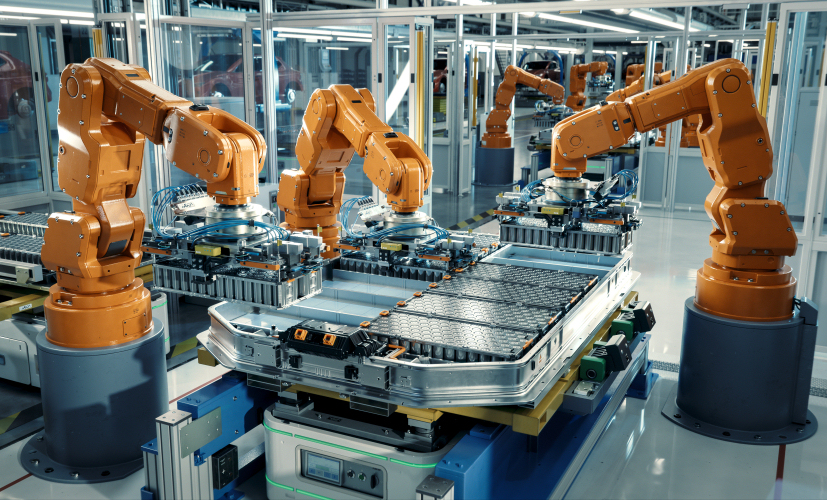
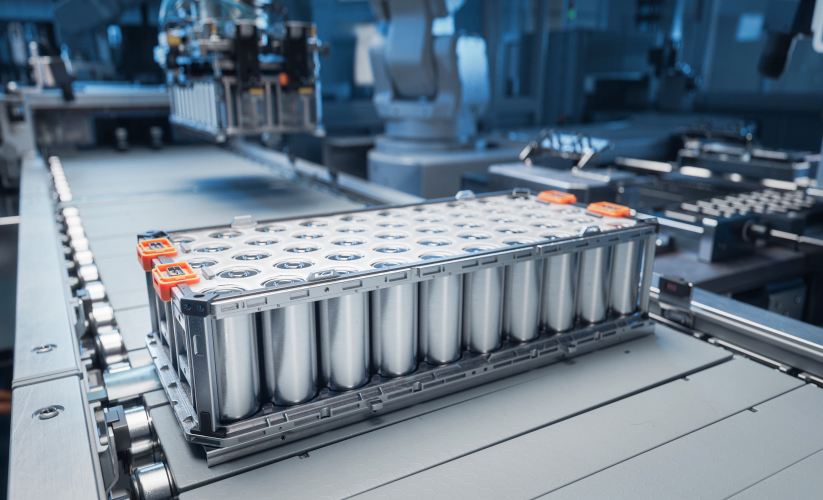
Battery production includes various specialised technologies from electrode production to cell assembly and module assembly and is certainly one of the current key technologies in automotive engineering. With the WinMOD-SIMLINE system, processes such as stacking, winding, cell housing joining, laser welding, electrolyte dosing or cell assembly can be virtually put into operation. The special feature is that you can use one and the same VIBN system for this. With WinMOD, you can easily create and test thermal management processes (heating, cooling, drying) and component assembly in one simulation.
You can link and test the individual workstations with their separate controllers together with the higher-level system controller in WinMOD at the same time. Of course, this also applies to robots that are used, for example, to assemble cells into complete packs. The robot behaviour is integrated here by coupling the manufacturer-specific simulation software to WinMOD - keyword CoSimulation.
Transport systems and CAD integration
The transport systems used in battery production range from classic roller conveyors to electric overhead and floor conveyors (EHB, EBB) and driverless transport systems (AGV, AGV). WinMOD-SIMLINE provides you with extensive 3D technology libraries for all these systems. For more information, simply go directly to the relevant WinMOD technology page.
You use the 3D CAD data of your components for virtual commissioning. After direct import, these can then be transported, accumulated, stacked, assembled and packaged in the 3D simulation in real time. You can use these virtual cells, housings and modules to produce virtual traction batteries with WinMOD and test your automation system in the process.
Further automotive solutions

Production area in which structural body parts and outer skin parts are produced from sheet metal coils or cut blanks by cold or hot forming - from the raw blank to the ready-to-install formed part.
Joins stamped/formed sheet metal parts, extruded and cast components into a dimensionally stable body structure - with defined geometry, rigidity, crash and NVH performance as a basis for painting and final assembly.
Highly automated system chains for surface pre-treatment, coating and curing of car bodies and add-on parts - designed for high throughput, reproducible appearance and corrosion protection.
Pre-assembly of front/rear axle modules as carriers for chassis, steering and drive units such as combustion engine, powertrain or e-axle. Transport up to the sequenced transfer to the „marriage“ with the body.

Highly automated process chain for the production of traction batteries - from electrode production, cell assembly and forming to module/pack assembly
This technology area comprises conveyor systems that transport and sort pallets and mesh boxes containing automotive components. The conveying elements are large roller and chain conveyors in combination with lifting, turning and sliding tables.
Fully automated high-bay warehouses that are operated by light or heavy-duty storage and retrieval machines and controlled via distributed automation systems. Warehouse management systems generate the orders for the storage and retrieval of body shells or complete car bodies.
Floor-bound conveyor technology in which car bodies or heavy modules are transported on standardised SKIDs (steel frames with vehicle-specific support points) through assembly, painting and buffer areas.

Overhead conveyor systems with electrically driven, individually controllable trolleys on monorail rails for low or high loads (up to the tonne range).
Ground-based conveyor technology in which car bodies or heavy assemblies are moved along rails on platforms. They are typically driven by friction wheels, push chain conveyors or push beams that continuously push the SKIDs forwards.